Real-world EV data
2026 Chevrolet Silverado EV Trail Boss (Max Range)Real-world range and efficiency
Standard Pickup Truck · 4-Wheel Drive · EPA 2.02 mi/kWh · EPA range 493 mi
Across 74 drives and 1,017 mi by 1 PlugLog driver, the 2026 Chevrolet Silverado EV Trail Boss (Max Range) averaged 2.04 mi/kWh, 14% below its EPA rating. That works out to about 411 mi of range.
From one driver so far: the numbers will firm up as more Silverado EV Trail Boss (Max Range) drivers share.
Updated · from 74 shared drives
Showing all shared Silverado EV Trail Boss (Max Range) drives
Reality check
Will a 2026 Chevrolet Silverado EV Trail Boss work for your life?
Put in where you live and how you drive: its range in your winters, what charging costs there, how clean your grid is, and how far it reaches on real roads.
- ❄ Winter range
- ⚡ Home charging cost
- 🌱 Your grid's CO₂
- 🗺 Real-road reach
Efficiency by outside temperature
Cold batteries and cabin heat cost range. Here's how much, for these drives.
- 32–50°F2.10 mi/kWh≈ 423 mi range · 15 drives
- 50–68°F2.36 mi/kWh≈ 473 mi range · 34 drives
- 68–86°F1.96 mi/kWh≈ 394 mi range · 25 drives
Longer bars go further on each kWh.
Efficiency by speed
Air resistance climbs quickly with speed. Here's what it costs, by each drive's average speed.
- 20–40 mph2.28 mi/kWh≈ 457 mi range · 64 drives
- 40–55 mph1.87 mi/kWh≈ 376 mi range · 6 drives
- 55–70 mph1.93 mi/kWh≈ 388 mi range · 4 drives
Longer bars go further on each kWh.
Carbon savings
US gridCO₂ for these 1,017 miles, tailpipe vs. the power plants that charged it.
717lb CO₂ avoided
▼ 61% less- Gas Silverado · 17 mpg1,172 lb CO₂59.8 gal burned
- This EV · US grid455 lb CO₂553 kWh charged
≈ 15 trees
growing for a year
8,461 lb
a year at 12,000 mi
Shorter bars are cleaner. Grid: EPA eGRID US average (0.82 lb/kWh) incl. charging losses; gas: 19.6 lb CO₂/gal.
Fuel savings vs. gas
US avg $4.28/gal · Oct 19What these 1,017 miles cost to charge, and what a gas Silverado would have spent.
$155saved charging at home
10.0¢/mi vs 25.2¢- Gas Silverado · 17 mpg$25625.2¢/mi
- Home charging · 18¢/kWh$10110.0¢/mi
- DC fast only · 43¢/kWh$23222.8¢/mi
$1,830 / year
at 12,000 mi, home charging
Break-even
fast charging under 48¢/kWh
Shorter bars cost less. Gas: EIA US weekly average; power: EIA residential average and PlugLog's real DC fast prices.
Only drives from drivers who chose to share their efficiency data, with no names or locations. Efficiency is distance ÷ the energy each battery reported using, net of regen. Real-world range is the usable battery, measured from shared drives (or estimated from the EPA figures), × the real efficiency, at the drives' average speed (weighted by distance, like the efficiency). EPA ratings include charging losses, so vs EPA compares at the battery. How it's measured
Questions
- What is the real-world efficiency of the 2026 Chevrolet Silverado EV Trail Boss (Max Range)?
- Across 74 real drives by 1 PlugLog driver (1,017 miles), the 2026 Chevrolet Silverado EV Trail Boss (Max Range) averaged 2.04 mi/kWh, 14% below its EPA rating. That's the energy its battery actually used, net of regen, not a lab test.
- What is the real-world range of the 2026 Chevrolet Silverado EV Trail Boss (Max Range)?
- About 411 miles on a full charge: its usable battery (about 201 kWh) at the 2.04 mi/kWh it averaged, at an average 49 mph. The EPA rates it at 493 miles.
- How much range does the 2026 Chevrolet Silverado EV Trail Boss (Max Range) lose in cold weather?
- Between 32°F and 50°F it averaged 2.10 mi/kWh, against 1.96 mi/kWh at 68–86°F: no less range in the cold, about 423 miles on a full charge.
Compare it
Other standard pickup trucks
All EVs- 2024 Chevrolet Silverado EV 4WT2.06 mi/kWh · 167 drives
- 2024 Chevrolet Silverado EV 3WT2.30 mi/kWh · 169 drives
- 2025 GMC Sierra EV2.05 mi/kWh · 116 drives
- 2026 GMC Sierra EV AT4 / Denali (Extended Range)2.38 mi/kWh · 117 drives
- 2026 Chevrolet Silverado EV LT (Extended Range)2.29 mi/kWh · 98 drives
- 2026 Chevrolet Silverado EV Trail Boss (Extended Range)2.35 mi/kWh · 18 drives
How it's measured
Real drives, straight from the battery.
EPA ratings come from a lab cycle. These come from the road: every drive shared by a PlugLog driver, recorded by the car itself.
Measured, not estimated
The PlugLog car app reads your battery's power many times a minute and checks it against the battery level. Efficiency is distance over the energy actually used, net of regen.
Shared on purpose
Drives count only if their driver shares their efficiency and charging data, and then all of them do, so no one picks their best. No names, no routes, no locations: just how the EV did.
Every condition
Cold mornings, highway runs, short hops. Filter by the weather, speed and trip length to see the numbers that match how you'd drive.
Track your own EV
Get numbers like these for your car.
PlugLog logs every drive and charge, works out what your EV really gets, and lets you share it to help the next buyer.
- Free
- Android Automotive car app
- Share only what you choose
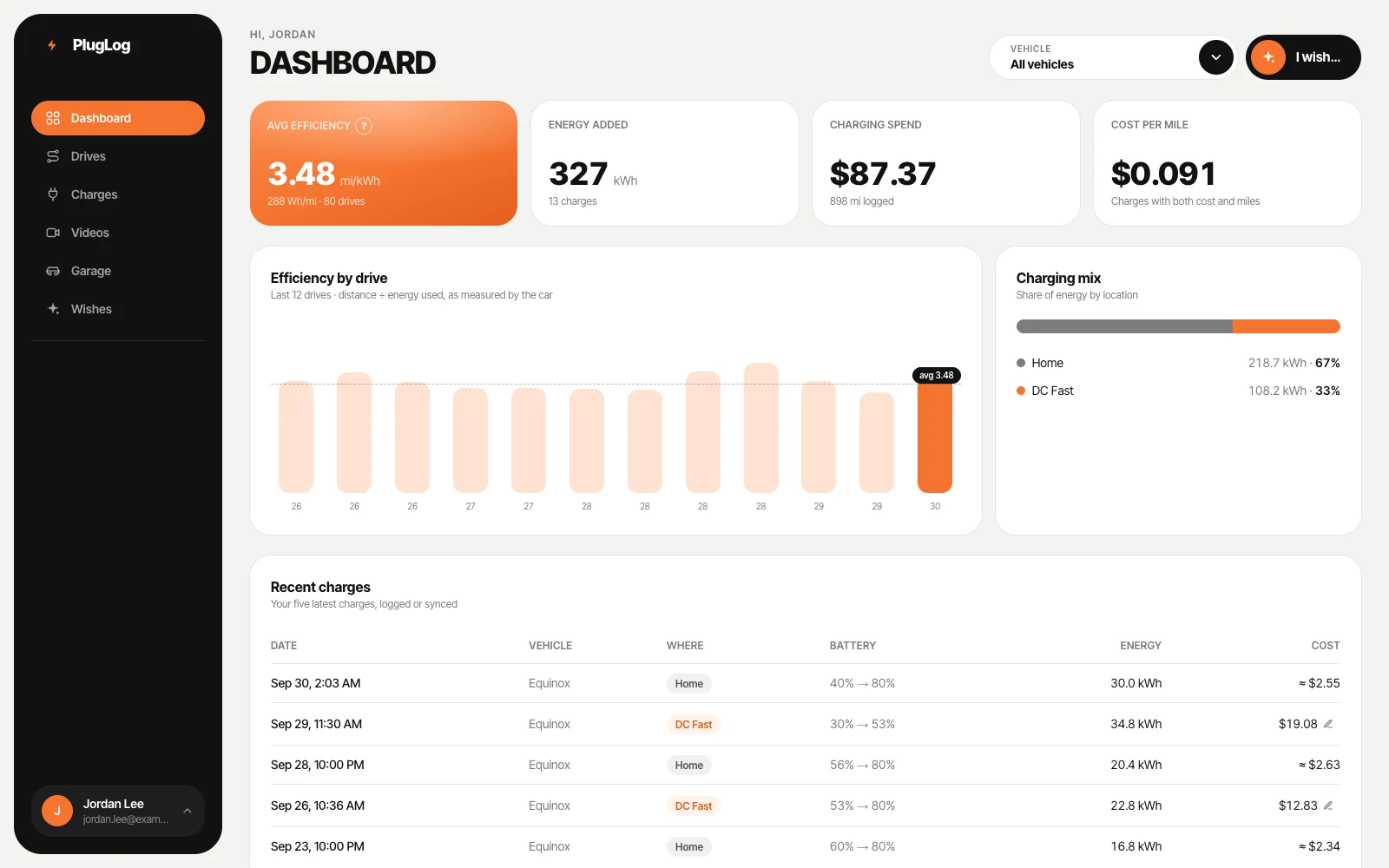
Your EV's dashboard
Your own efficiency, energy added, charging spend and cost per mile, drive by drive.
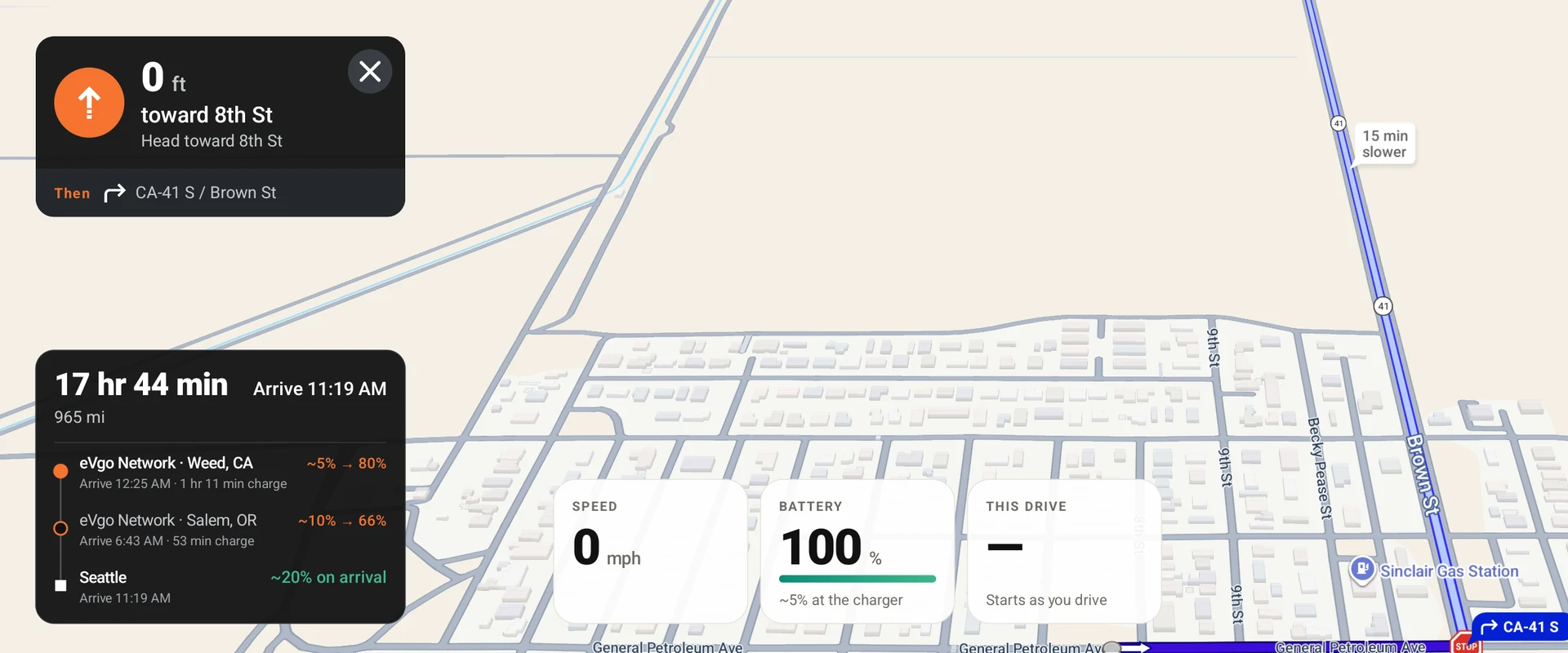
Live in your car
On Android Automotive, PlugLog navigates, plans your charging stops, and records every drive and charge on its own, with this drive's efficiency on the map.
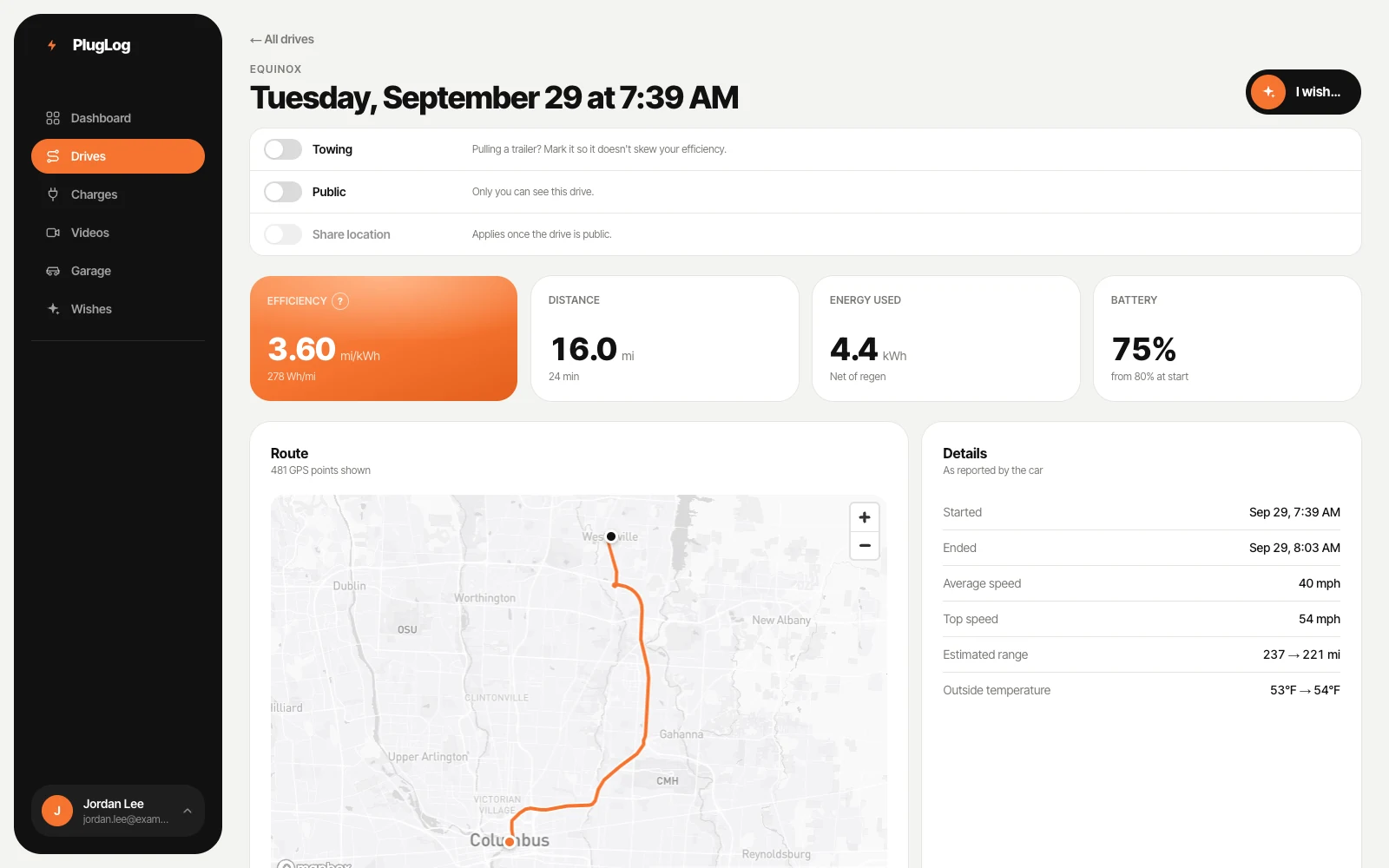
Every drive, second by second
Where the energy went, driving, regen and stopped, with the route, speed and battery level.
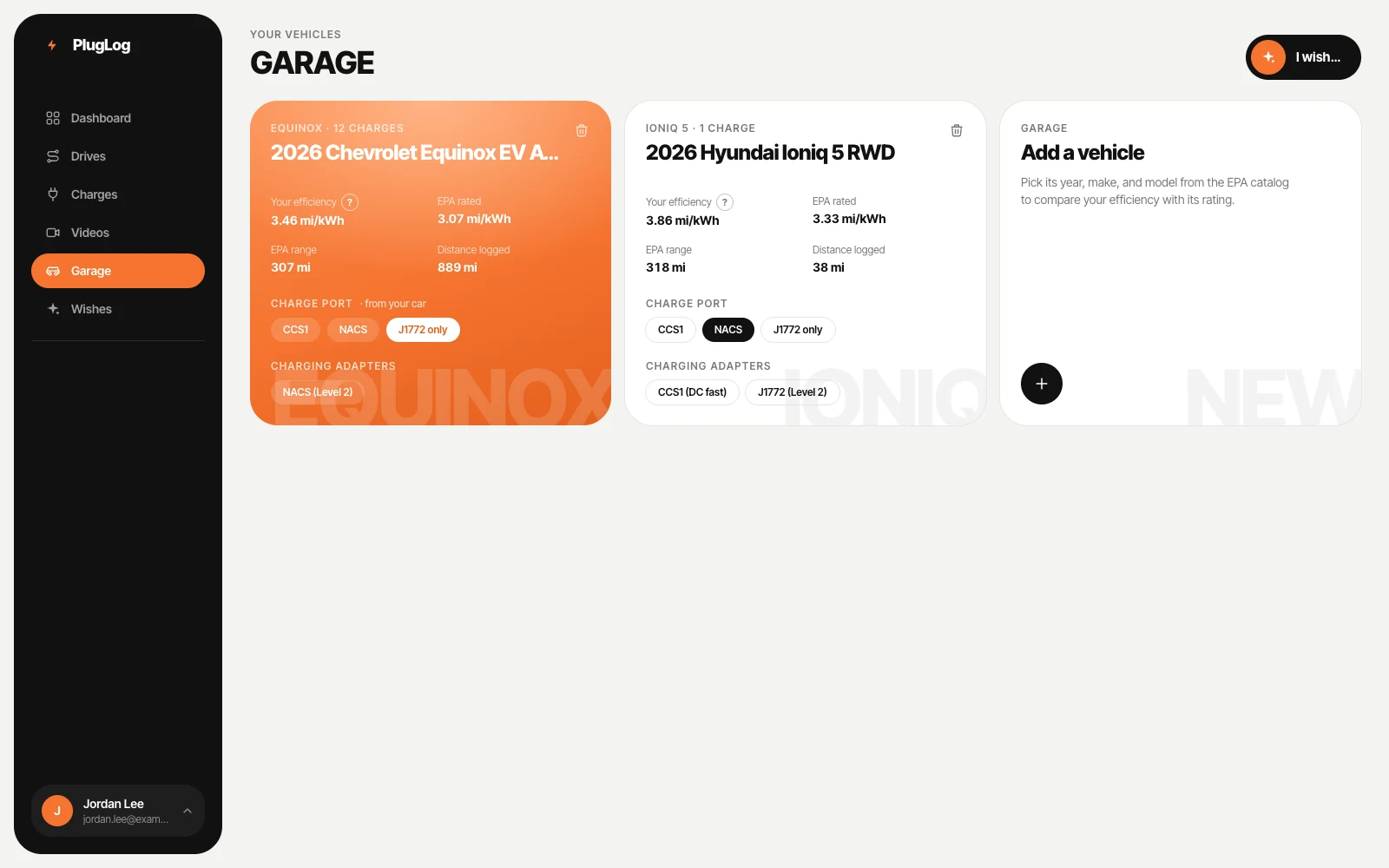
You vs the EPA rating
See how your EV compares with its rating, and share your drives to add to the numbers above.
Your EV belongs on this page.